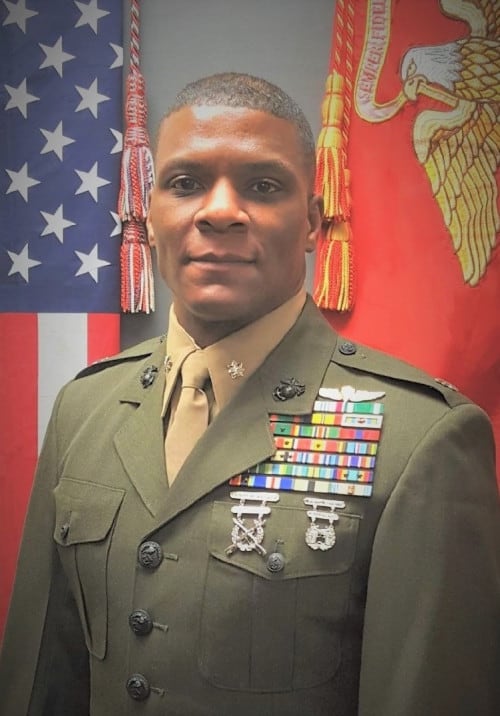
Black History Month Spotlight: Lt. Col. Cameron McCoy on the Importance of Representation

Commanding Officer, 3rd Battalion, 23rd Marine Regiment, 4th Marine Division, Marine Forces Reserve

Based on an interview conducted by Gidget Fuentes, Seapower Correspondent

I am a university professor of American history and military history. I got here August 2019. I was teaching at Brigham Young University full-time and was looking for a change. The Air Force Academy had an opening, and it fit what I did as a military and diplomatic historian as well as a historian on race in America.

From just a young age, I felt it was important to serve the country. I did Air Force ROTC in high school. I thought, let’s just go into the toughest branch and test yourself to the limit, so I chose the Marine Corps. I enlisted at 17, did my years and then got out.

I went to Spain for two years on a [church] mission. Before I left, I kept running into retired lieutenant colonels or full-bird colonels back home in D.C. social environments who’d say, have you thought about going back in and being an officer? I was not interested.

While I was in Spain, I prayed about it, and it became as clear as day to me that is what I should do. I went to the Platoon Leaders Course and Officer Candidates School, and I graduated No. 1, but I hadn’t committed. Then Sept. 11 happened. I had just started my senior year at BYU and made the decision. If I don’t go, who the hell else will? I graduated BYU in April 2002. I finished The Basic School, got assigned infantry on May 15, 2003. I go to Infantry Officers Course. We left September 2004 [for Iraq], and I was back in country June-July 2005.

I went to Texas A&M for my master’s degree in military history. I then got my Ph.D. at the University of Texas-Austin. I joined the Reserves in 2010.

I took 3/23 command on Nov. 15, 2020. We’re still drilling and taking lots of [COVID-19] precautions. Everyone’s masked up and social distancing. The day I took command, the entire battalion was together. I gave them my philosophy, that I am there to facilitate their growth that I believe they are all capable of.

In 18 years, going on 19 years in the Marine Corps, I’ve never seen a black battalion commander. I can count on eight fingers how many black lieutenant colonels and black colonels I’ve seen with my own eyes. I’ve never ever met a black infantry battalion commander.

One thing I’ve learned as a historian and that I know as a professional scholar is that people don’t change until they’re back into a corner or you hit them in the pocketbook.

One easy way is to start putting people into positions where they can see themselves. Do I believe I can become a general in the Marine Corps? I’m not sure. I’ve only met one black general in my entire life, and he was retiring.

It starts with policy. Somebody asked me, what will change things? There’s four: policy, teachings, attitudes, perceptions. We avoid teaching difficult histories. People just have specific attitudes toward people who don’t look like them, and there’s perceptions about that as well. I’m finishing up a book, an outgrowth of my dissertation, already under contract with the University Press of Kansas. It’s called “Contested Valor: African-American Marines in the Age of Power, Protest and Tokenism.”

Navy League News