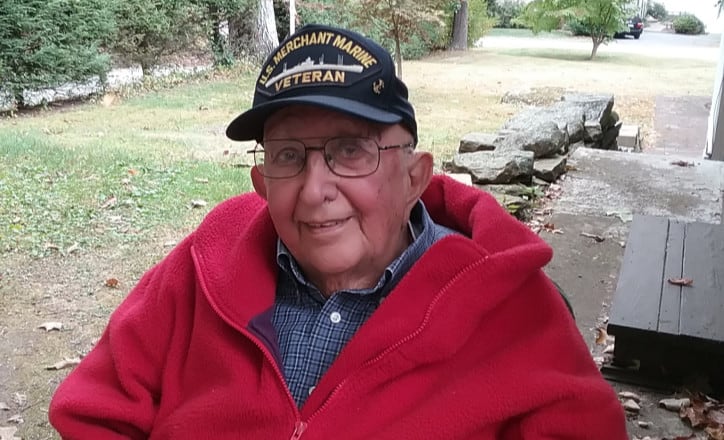
Highlighting Our Heroes: Russell Inzinga

Highlighting Our Heroes: Russell Inzinga

By Luke Lorenz
Director of Legislative Affairs

Navy League of the United States

This is part of an ongoing series, where we look at the lives and legacies of U.S. sea service men and women.

We all walk our own paths in this life. But for the lucky few among us, those brave enough to put their fate in the hands of destiny, sometimes a ship comes along to carry us through tough times and rough seas. I’m not speaking metaphorically. This is the story of Russell Inzinga and the U.S. troop transport ship E.B. Alexander.

Nearly two decades before Russell Inzinga entered the world, a German transatlantic passenger liner began its seafaring career. The vessel, named Amerika, sailed across the Atlantic transporting people from Europe to the United States and back again. It is odd to think that while this vessel would experience two World Wars between the powers of Europe and America, as a passenger ship it was uniquely positioned to see the humanity of all caught in the perilous battles. This vessel transported hungry families in search of a better life. It took nervous troops across the seas to fight. It brought back prisoners of war, broken and weary from the war. And when all the guns went silent, it even reunited the lovelorn wives of deployed soldiers long separated by the conflict. Perhaps no human being could have formed a  better understanding of the people that fought and sacrificed in these wars than this floating oasis.

The destiny of the S.S. Amerika would forever change only two years before the birth of Russell Inzinga. While docked in Boston, the United States and Germany officially entered into war and the ship was seized. Now the USS America, it was used to transport tens of thousands of troops to France and after the war ended it transported even more troops back home to the United States.

In 1921, Russell Inzinga was born in Willimantic, Connecticut. He had a big family, and they had a big garden. In the peace of the post war years, Russell enjoyed both. Oddly enough, at the time of Russell’s birth, the USS America underwent a sort of rebirth itself. After a massive fire, much of the ship was rebuilt and it continued its mission of transporting people across the Atlantic.

In 1942, at the age of 22, Russell joined the Merchant Marine. His family was proud of his decision to join the war effort, but they were worried too, knowing the risks and dangers that awaited him. His first stop was the Merchant Marine training facility in Sheepshead Bay, Brooklyn. After his training he was assigned to the E.B Alexander, the newest moniker of our old friend the USS America. This would be the start of a four-year adventure for the two of them, both uncertain of what the dangerous waters had in store amidst the perils of WWII.

Russell’s first trip aboard the E.B. Alexander took him to Scotland along with thousands of U.S. Army troops prepped for the invasion of northern Europe. The American soldiers departed, each one marching into a future known only to fate. The ship was empty for a brief moment, until a new group of Canadian soldiers boarded headed for the sunny (but bullet-ridden) beaches of Sicily.

They sailed through the Straits of Gibraltar headed for the Port of Augusta. German planes still controlled the skies and they would enact a brutal toll on the Santa Elena, another ship in his convoy. The Germans bombed the Santa Elena but it managed to hobble its way to shore. Russell’s convoy followed it to Oran, Algeria, where they were able to take the troops off that ship and move the convoy on to Sicily. After the Canadians got off in Sicily, they sailed to another port on the small island and a group of British soldiers boarded, en route to Liverpool.

There would be two exceptions to this routine of transporting allied troops either going to or returning from battle. One exception was the transport of German POWs. Guarded by Army Military Police, Russell did not meet these men. His job was to take them to justice. How strange to think of the many different faces that the E.B. Alexander presented to its various guests. For American and Canadian forces going into war, the Alexander was a mysterious ferryman taking them to a fate unknown. For British troops returning to Liverpool it was deliverance, reuniting them with relieved loved ones. For German POWs returning home, it was retribution for their misdeeds. For Russell and the crew, it was just home. How can one place have so many different meanings?

Russell sailed back and forth with his crewmates on the Alexander with very little turnover. He remembers that all the men were young and, for many of them, the Alexander was part of an adventure. The enemy waited under every wave and behind every rocky outcropping, but the Alexander and its crew sailed on courageously. They worked hard, but got along well.

After 18 crossings, the Alexander stopped in Baltimore to be repainted. Russell Inzinga hopped off the boat and headed off for a new life. He had made so many voyages that he was not required to go back into the war effort. He opened a barber shop in Manchester, Connecticut. The Alexander saw its last voyages transporting the spouses of soldiers stationed in Europe. Bringing loved ones together would be its final gift before it was retired and taken apart.

Russell continued working as a barber, but something was nagging at him. The Merchant Marine did not receive the same recognition as others who had served during the war. For one thing, they did not get the GI Bill. If they had, Russell might have chosen to go to college as other veterans were doing. He wanted those Merchant Marine that fought so bravely to be honored correctly. This desire would lead to an impressive one-man campaign for recognition.

Every year, on Memorial Day, the people of Willimantic do their patriotic duty and honor veterans from all the services. But in the local park, there was no recognition of the Merchant Marine. So, Russell bought a plaque and after much interaction with government officials he was allowed to install the plaque in Memorial Park on Main Street so the Merchant Marine would be honored alongside all the other branches.

Russell Inzinga worked as a barber for 68 years. In the end it would be Russell himself who was honored. In June of 2015, the town of Manchester presented an official proclamation to recognize Russell for over 50 years as the owner and operator of Russell’s Barber Shop. Russell donated the content and equipment of his barbershop to the Manchester Historical Society. In 2018, the Cheney Brothers National Historic District Commission presented an award to Russell for his 68 years of barbering and his contributions to the East Side Neighborhood where the barbershop building is located.

Now in 2021, Russell and his family look forward to celebrating his 100th birthday. He still flies the American flag and the Merchant Marine flag in his front yard, honoring all those who served and continue to serve. Russell is still going strong, but he can rest easy knowing his legacy is forever secure just like that of the E.B. Alexander.

Highlighting Our Heroes